
Turn alarm storms into a contextualized operational response
Coolbit AI uses machine learning, electrical and mechanical topology, and dependencies between equipment to correlate events, identify the root cause, suppress false positives in milliseconds, and connect the incident with the response flow your organization defines.
From detection to resolution, every event can be recorded in an immutable log for review and audit.
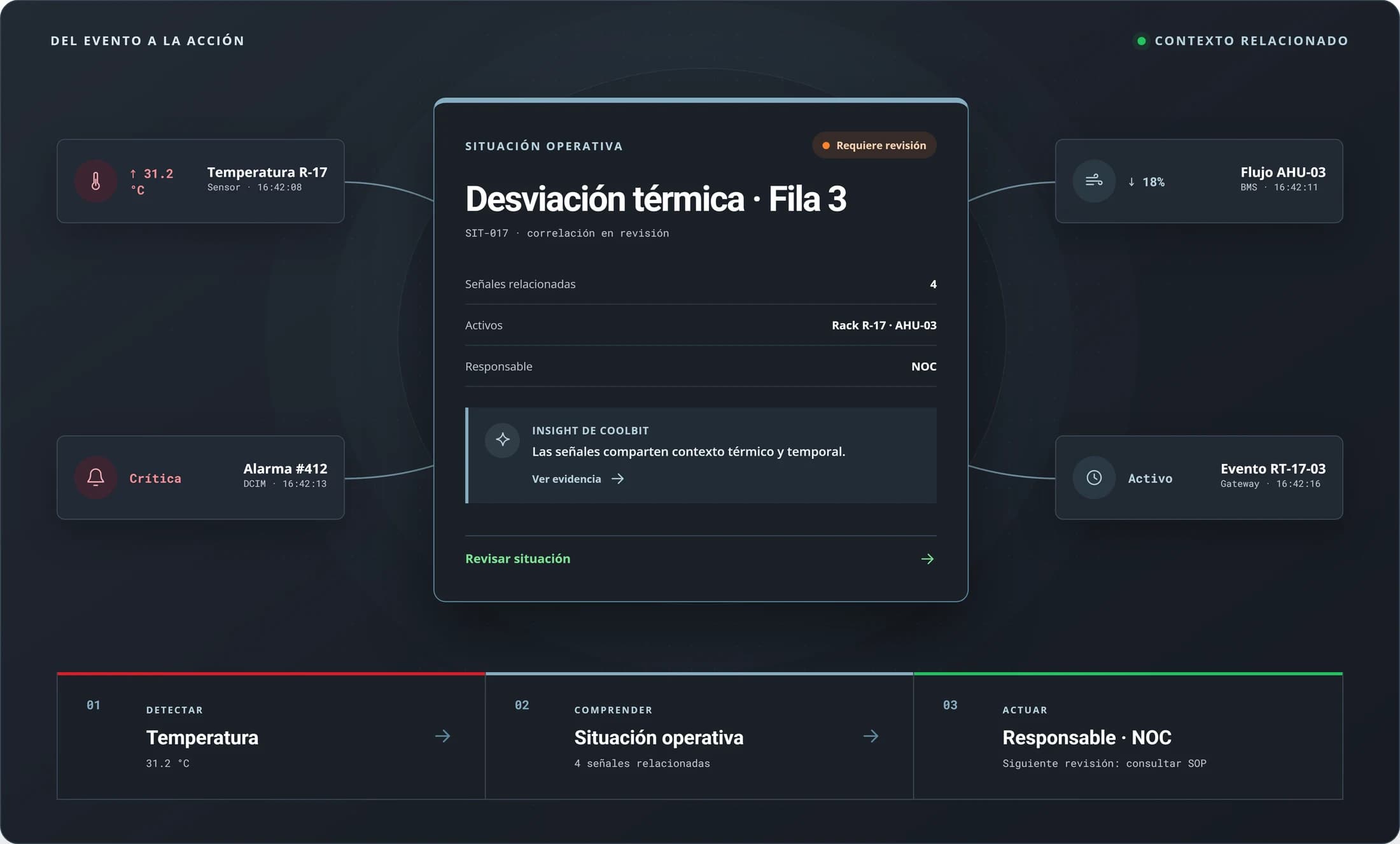
Alert fatigue
An alarm storm can hide the signal that actually matters
Monitoring systems are essential for detecting deviations. The problem appears when the same condition triggers multiple thresholds and each system presents the event from its own logic.
During an electrical, thermal, or mechanical failure, the team can face simultaneously:
The challenge isn’t receiving more alerts.
It’s identifying what’s happening, what the cause is, and what needs attention first.
From isolated alerts to an operational situation
The alarm is a signal. Coolbit AI reconstructs the situation.
Instead of presenting each event as an independent unit, Coolbit AI correlates available information to build a contextual view of the incident.
An operational situation can bring together
Machine learning
Contextual routing based on machine learning
Coolbit AI uses machine learning to analyze signals and patterns within the infrastructure’s real context. The model doesn’t just check whether a value crossed a threshold. It also considers the available relationships between:
Less time interpreting disconnected events, more context for acting on the incident.
Electrical and mechanical topology
Understand the alarm within the physical architecture that produces it
A signal changes meaning once you understand its position within the infrastructure. Coolbit AI uses the site’s real electrical and mechanical topology to contextualize relationships between equipment and events.
Electrical topology
Can add context about relationships between components such as:
Mechanical topology
Can add context about:
Dependencies
Coolbit AI can relate how a condition on one asset affects or is reflected in other connected elements.
The goal isn’t only knowing which alarm went off, but understanding where it sits within the system.
Root cause and false positives
Identify the root cause and suppress false positives in milliseconds
Coolbit AI combines machine learning, temporal correlation, topology, and dependencies to analyze the incident at a speed that doesn’t depend on manually reviewing each dashboard.
Identifies the root cause
Relates the signals that describe the same incident and locates the condition that originates the chain of events.
Suppresses false positives
Distinguishes signals that don’t need to become independent incidents and keeps them from competing for the operator’s attention.
Processes in milliseconds
Runs the analysis and correlation with millisecond latency to bring context to the operator from the incident’s earliest stages.
Keeps traceability
Operational suppression doesn’t mean deleting evidence. Events and processing decisions remain available within the incident’s traceability.
Less noise. More context. Root cause visible from the start of the response.
Response cycle
From detection to resolution within a single flow
Detection
Receives and analyzes signals from the incorporated sources.
Correlation
Groups related events using machine learning, context, and dependencies.
Diagnosis
Identifies the root cause and suppresses false positives.
Prioritization
Presents the situation according to the defined operational and risk criteria.
Response
Connects the incident with the owner and the corresponding response route.
Mitigation
Surfaces SOPs, MOPs, or EOPs related to the asset and condition.
Resolution
Logs the sequence of events, actions, and times in an immutable record.
Review
Information stays available for audit, post-incident analysis, and reporting.
Assignment and escalation
Dynamic escalation based on severity and your operation’s rules
When the flow is configured, Coolbit AI can orchestrate the distribution of work considering information such as:
Automation runs previously defined rules; the organization keeps governance of the workflow.
SOPs and EOPs
From root cause to the procedure that guides the response
Once the incident has context, Coolbit AI can relate it to authorized operational knowledge.
The flow can incorporate
“I know what’s failing”
“I know which procedure to review”
MTTR and SLA
Reduce the friction that drives MTTR up
Part of an incident’s resolution time can be consumed before mitigation even begins:
Coolbit AI automates and connects several of these stages to help reduce Mean Time to Recovery (MTTR).
SLA protection
A faster, contextualized, and documented response also helps lower operational risk around service commitments.
Audit and immutable log
A chain of events that doesn’t end when the alarm disappears
Coolbit AI generates an immutable log of the chain of events and the exact intervention times. The log can gather available evidence from detection to resolution:
Illustrative scenario
A thermal deviation triggers a chain of alarms
A sensor detects a thermal deviation.
Coolbit AI analyzes related signals using machine learning.
The platform reviews the asset’s relationship within the mechanical topology and available dependencies.
Identifies the root cause associated with the incident and suppresses signals classified as false positives.
The operator receives a consolidated view with:
The situation advances according to the configured rules.
The operator consults the related SOP or EOP and runs the authorized process.
Each stage is added to the immutable log.
The incident can later be analyzed to review MTTR, SLA, process, and improvement opportunities.
This scenario is illustrative. It doesn’t represent a client case or demonstrate a reduction in time, incidents, or MTTR.
Control and governance
Automate analysis without losing governance of the operation
Coolbit AI can automate correlation, cause identification, false-positive suppression, and escalation workflows.
AI detects, correlates, and orchestrates. The organization governs how it’s acted on.
The organization keeps control over
Related use cases
The alarm is the start of an operational story
Demo
Follow an alarm from signal to resolution
Review a scenario where Coolbit AI:
Frequently asked questions
Questions about smart alarm management
Yes. Coolbit AI uses machine learning to analyze signals, patterns, context, and relationships between events within the alarm management flow.
Yes. Electrical and mechanical topology is part of the real context Coolbit AI uses to interpret dependencies and relationships between assets.
Yes. Coolbit AI combines correlation, machine learning, topology, and dependencies to identify an incident’s root cause.
Root cause analysis and false-positive suppression run with millisecond latency inside the processing engine. The end-to-end experience also depends on each deployment’s sources, connectivity, and integrations.
Yes. Coolbit AI can identify and suppress signals classified as false positives to keep them from unnecessarily competing for the team’s attention.
Operational suppression doesn’t mean deleting evidence. Events can remain within the incident’s traceability and log.
Yes. Coolbit AI generates an immutable log of the chain of events and intervention times to support post-incident analysis and audit.
Yes, when the workflow is configured with owners, shifts, rules, and channels available for the implementation.
Coolbit AI automates steps that consume time during diagnosis and coordination. The quantitative impact on MTTR must be measured per implementation and period.
It should not be presented as a contractual guarantee. It helps improve context, response speed, and traceability — relevant factors for managing SLA risk.
No. Coolbit AI uses data and events from the incorporated sources and adds a layer of operational intelligence and response orchestration.
Go from receiving alarms to orchestrating the response
See how Coolbit AI uses machine learning, real electrical and mechanical topology, and dependencies to identify the root cause, suppress false positives in milliseconds, escalate the incident, and keep the whole chain in an immutable log.