
Turn operational data into reports that explain what happened
Coolbit AI correlates time-series data, historical records, and site knowledge to turn scattered operational information into narrative reports that explain what changed, what’s related, and what’s worth reviewing.
The explanation depends on the available sources and must be validated before use in a decision.
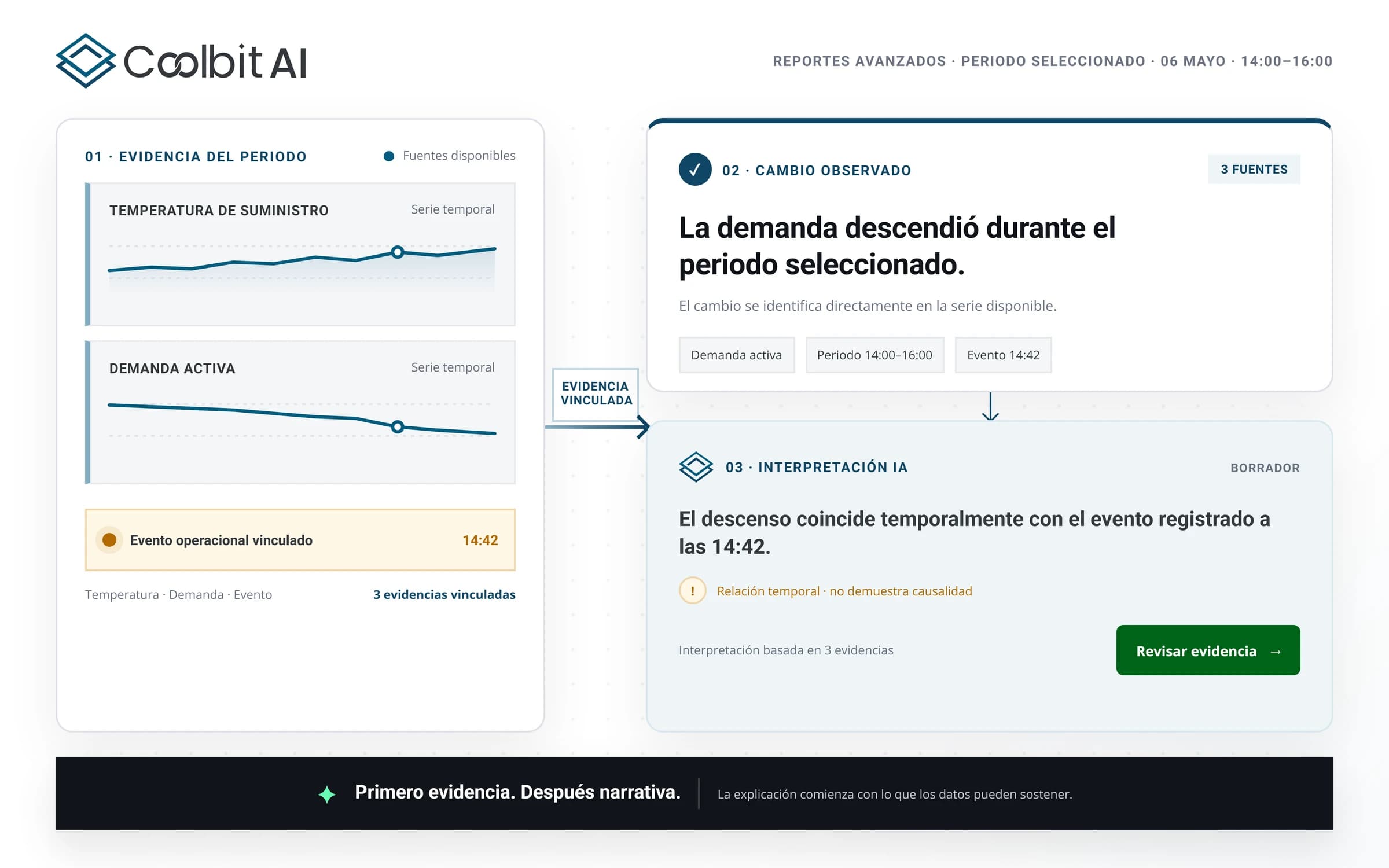
Dashboard vs. explanation
Your dashboards show what happened. The work begins when you need to explain it.
Monitoring tools let you see variables, trends, and events. But when Operations or Leadership need to understand a period, the team still has to manually reconstruct the story.
That can mean
Coolbit AI helps turn that scattered work into a structured explanation of the period.
A dashboard presents information. An assisted report should help you understand what changed, what’s related, and what needs review.
Transformation
From visualization to actionable knowledge
Dashboards show variables, trends, and events. The added value appears once that data can be related to its context to become an explanation the team can use. Coolbit AI takes on part of the heavy lifting of correlating time-series data, historical records, and operational context to turn scattered information into actionable knowledge.

What happened
Organizes the relevant events and changes within the selected scope.
What changed
Relates variations to the available historical data to show differences in the period’s behavior.
What’s related
Groups signals, alarms, conditions, and context that coincide within the analysis.
What needs attention
Highlights points and recommendations that Operations can review with technical judgment.
What it means for the decision
Turns technical information into an explanation usable as context for operational, executive, and financial decisions.
What we can’t state yet
Makes visible missing data, limitations, or relationships that don’t demonstrate causality.
Actionable knowledge means contextualized information for review and decision-making; it doesn’t imply automatic execution or confirmed causality.
Report anatomy
From an operational period to a reviewable explanation
The report can be structured so the information is understandable and verifiable.
Analysis context
Period summary
Changes and trends
Operational context
Points for review
Limitations
The report should clearly distinguish what was observed, what was interpreted, and what needs validation.
Sample report
This is what an assisted explanation of the operation can look like
Operational report — [Site]
Pending validationSummary
During the selected period, changes were identified in [available variables] and related events that require review.
What changed
Context
What’s worth reviewing
This example shows the report’s narrative structure. It doesn’t represent real data or confirm that all fields are available in the product.
Mechanism
From industrial data to a narrative report
The report’s value doesn’t come only from summarizing data. Coolbit AI combines temporal correlation and generative interpretation to structure the period’s context.
Define the scope
Select the site, the period, and the question you need to answer.
Gather the available sources
Coolbit AI works with the data, historical records, events, and operational knowledge enabled for the scenario.
Correlate time series
Relates the behavior of variables and events within the period to identify changes and coincidences worth reviewing.
Interpret context using generative models
The baseline content establishes that Coolbit AI uses advanced generative models to interpret industrial metadata and turn correlated information into a comprehensible explanation.
Generate a linguistically rich, contextualized report
The output organizes data, changes, context, and recommendations in understandable language so the team doesn’t have to manually build the whole narrative of the period.
Validate before using it
Operations reviews sources, limitations, interpretations, and recommendations before sharing the report or using it to support a decision.
Correlation isn’t causation. Recommendations must stay under human review.
Sources and trust
An explanation is useful when you can understand what it’s based on
The report’s quality depends on the information available for the period and the defined scope.
Sources may contribute (subject to technical validation)
Only sources with approved integration and documentation should be presented as compatible.
Consultative intelligence
From actionable knowledge to a permanent consultative intelligence
The baseline content defines the next evolution as Permanent Consultative Intelligence: reports that don’t just deliver the requested data, but complement it with interpretation, trend analysis, and recommendations. In Coolbit AI’s commercial proposal, this consultative layer turns the report into a bridge between the infrastructure’s technical reading and the decisions Operations, Leadership, and Finance must make.
Coolbit AI supports operational and financial decision-making; it doesn’t direct or automate those decisions.
The term “permanent” requires confirming the capability is continuously available and defining its update frequency.
Core applications
Use the report for three recurring tasks
Explain an operational period
Organizes the changes, events, and points needing follow-up.
Review an event after it happened
Gathers available information to make later analysis easier.
Communicate the operation to other areas
Turns technical data into a structured explanation that can be reviewed before sharing.
These three applications form the page’s operational core. The consultative value that can support executive and financial conversations is built on top of them, without attributing the final decision to AI.
Conditional applications
Extend the analysis once the necessary data and rules exist

Condition-based maintenance
Can provide trends or signals to prioritize a review when approved data and criteria exist.
Energy and efficiency
Can organize available energy variables for analysis. Doesn’t imply savings or PUE reduction by default.
SLA
Can help structure related events and metrics. Doesn’t demonstrate contractual compliance on its own.
Compliance
Can support organizing information for a review. Doesn’t certify compliance.
The availability and scope of these applications depend on the sources, metrics, rules, and functions confirmed for the implementation.
Related use cases
The report closes a story that starts earlier
A report can be the last step of a flow that began with an operational event.
This relationship helps present Coolbit AI as a coherent operational intelligence system, not three isolated features.
Demo
Generate an explanation, not another collection of data
Select a scenario and see how Coolbit AI correlates the period’s information and turns it into actionable knowledge: changes, related events, context, trends, and points for review.
Frequently asked questions
Questions about AI-assisted reporting
A dashboard presents indicators and events. The report organizes a period’s information and prepares a structured explanation for review.
It depends on the available sources and the approved scope. It can consider period data, historical records, events, and operational knowledge brought into the scenario.
The baseline content establishes that Coolbit AI uses advanced generative models to interpret industrial metadata and turn correlated information into a narrative explanation. The architecture and exact scope of that capability must be documented before final publication.
It describes an interpretation layer that complements a period’s data with trends and recommendations for review. The term "permanent" requires validating continuity, availability, and update frequency.
Yes, as context for evaluation. The report can help Operations, Leadership, and Finance work from a shared interpretation of the information. Decisions remain under human responsibility.
It can relate information and provide context to guide the analysis. It shouldn’t present a cause as fact without sufficient evidence and technical validation.
It shouldn’t be presented as a general capability. A prediction requires models, data, a defined window, and accuracy metrics.
It can present points or recommendations for review. The team keeps the decision and must validate any action.
Only when specific data, baseline, methodology, and evidence exist. It shouldn’t be presented as a general outcome.
It can organize available events and metrics related to the period. It doesn’t replace contractual rules or guarantee compliance.
The ability to show references, sources, or traceability must be confirmed in the demo and technical documentation.
The explanation must be limited to the available information and state what needs further review.
Formats, export, scheduling, and distribution must be confirmed before being published as features.
Move from visualizing data to working with actionable knowledge
Generate a sample report and see how Coolbit AI correlates time series, historical records, and context to produce a consultative explanation that can support operational review and decision-making.